December 22, 2025
2025 in Review: HIV Vaccine Research Through the Eyes of African Scientists
Researchers leading HIV vaccine research work in Africa offer their perspectives on a turbulent year with global implications.
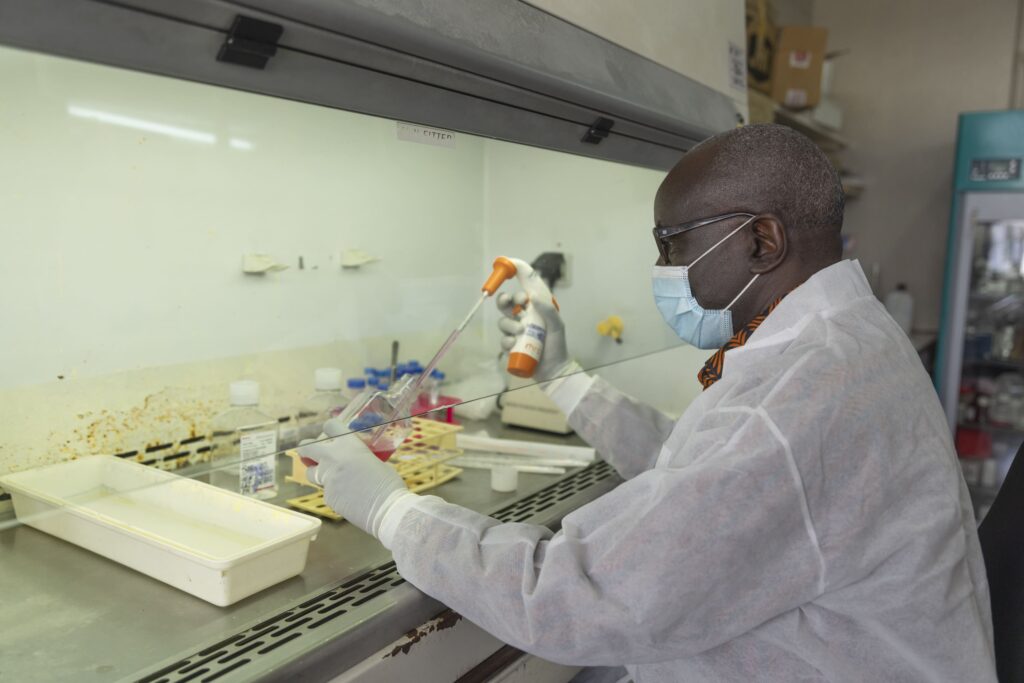
Paradox defined HIV vaccine research in 2025. Clinical trials delivered some of the most promising results in decades alongside severe funding disruptions. As USAID terminated support early in the year for research consortia, some programs shuttered and networks dissolved. Yet, African institutions stepped forward and a new narrative has begun to emerge.
Here, researchers leading this work from Africa offer their perspectives on a turbulent year with global implications.
Scientific Progress Amid Uncertainty
Despite financial turbulence, 2025 marked a turning point for HIV vaccine science. IAVI’s G002 and G003 trials validated germline targeting, a strategy to train the immune system to produce broadly neutralizing antibodies. Amsterdam UMC’s IAVI C101 study showed parallel success, and Oxford’s T-cell vaccine program reported encouraging results.
“Across the board we are seeing positive outcomes that say we should really be doubling down on HIV vaccine science, not taking steps back,” IAVI’s Dr. Vincent Muturi-Kioi says. “Right now we are as optimistic as we have ever been that we can actually develop an effective vaccine against HIV.”
Defunding and Its Ripple Effects
The termination of USAID funding in early 2025 sent shockwaves through the research ecosystem. Some African laboratories closed, and the BRILLIANT Consortium—USAID’s first direct investment in African-led HIV vaccine R&D—lost most of its funding.
“The feeling was incredible dismay, disappointment, frustration,” recalls Professor Linda-Gail Bekker of the Desmond Tutu HIV Centre and an IAVI Board Director. “[A fully funded BRILLIANT Consortium] would have meant testing vaccines of our own choice and in some cases vaccines manufactured here on the continent,”
African institutions responded quickly after the USAID closure: The South African Medical Research Council provided bridge funding to wind down studies properly or allow them to continue, and the SANTE Network repurposed grants to retain early-career scientists. Research networks consolidated to pool resources, and African governments explored in-kind support such as tax exemptions and infrastructure provision.
African Leadership Comes of Age
When U.S. labs withdrew from analyzing IAVI G004 trial data, Kenyan institutions KEMRI and KAVI assumed full responsibility.
“We are now leveraging the capacity we’ve built over time,” says Dr Kundai Chinyenze of IAVI. “Data will now be 100% generated on the continent.”
This shift—from capacity building to capacity utilization—extends beyond HIV. “HIV funding provided a scaffolding effect holding up the entire infrastructure to respond to outbreaks such as Sudan, Marburg, Mpox,” Chinyenze notes. “What is at stake goes a whole lot more beyond HIV to pandemic preparedness.”
Why a Vaccine Still Matters
With lenacapavir showing near-complete efficacy as twice-yearly injectable PrEP, some question whether vaccine development remains necessary. Researchers say it does.
“We need something that transcends stigma, transcends the need for regular dosing, transcends the need for health systems that function,” Bekker argues. Muturi-Kioi adds: “You could vaccinate all 15-year-olds without categorizing them by risk.” Current HIV prevention focuses on high-risk identification, “which runs the risk of … people who could benefit missing out.”
Rethinking Funding Models
The crisis has sparked calls for sustainable financing. Chinyenze advocates for coordinated, long-term funding: “Funders need to create conglomerate funding where one funder covers two years, another bridges the next three. Researchers experience continuous long-term support instead of diffuse, short-term grants.”
She also urges cost parity for African institutions and integration of research sites with health systems to attract government co-investment.
The Road Ahead
“In 2025, we are five years away from the 2030 goal that UNAIDS set to bring the epidemic under control,” Bekker notes. “Ultimately, ending this epidemic is going to require a vaccine that is safe, durable and effective. It is beyond urgent that we get that research done now whilst we have the expertise, the willing communities, and the technology.”
“We are a resilient field that does not easily give up,” she reflects. “It has been incredibly gratifying to see groups come together alongside loyal funders, figuring out what we can do with the resources we have.”
The science is ready. The question is whether funding and political commitment will rise to meet it.