January 14, 2026
Epidemiology studies strengthening data management capacity for future Lassa fever vaccine trials in Sierra Leone: a conversation with Foday Alhasan
Strengthening data management capacities is helping ensure institutional readiness for future Lassa fever vaccine trials in Sierra Leone
Outbreaks of deadly hemorrhagic fevers are increasing. In West Africa, up to 500,000 people fall ill each year with Lassa fever, a life-threatening viral hemorrhagic illness—and its footprint is expanding. Despite this growing burden, little has been known about the natural history and epidemiology of Lassa virus (LASV). With several Lassa fever vaccine candidates in development, epidemiologists have been urgently studying the natural history, burden, distribution, and determinants of the disease to prepare for efficacy trials needed to support vaccine licensure.
IAVI X100 is one such effort. A collaboration between the Viral Hemorrhagic Fever Program at Kenema Government Hospital (KGH-VHF), Tulane University, and IAVI, this Wellcome-funded prospective cohort study is characterizing the epidemiology of Lassa fever in Sierra Leone. X100 was designed to harmonize with the CEPI-funded Enable study being conducted in complementary regions of Sierra Leone. Data from these studies will be crucial for designing and implementing pivotal Phase 3 trials for Lassa fever vaccines. These epidemiology studies are also strengthening the capacity for key operational components of future successful trials, such as data management.
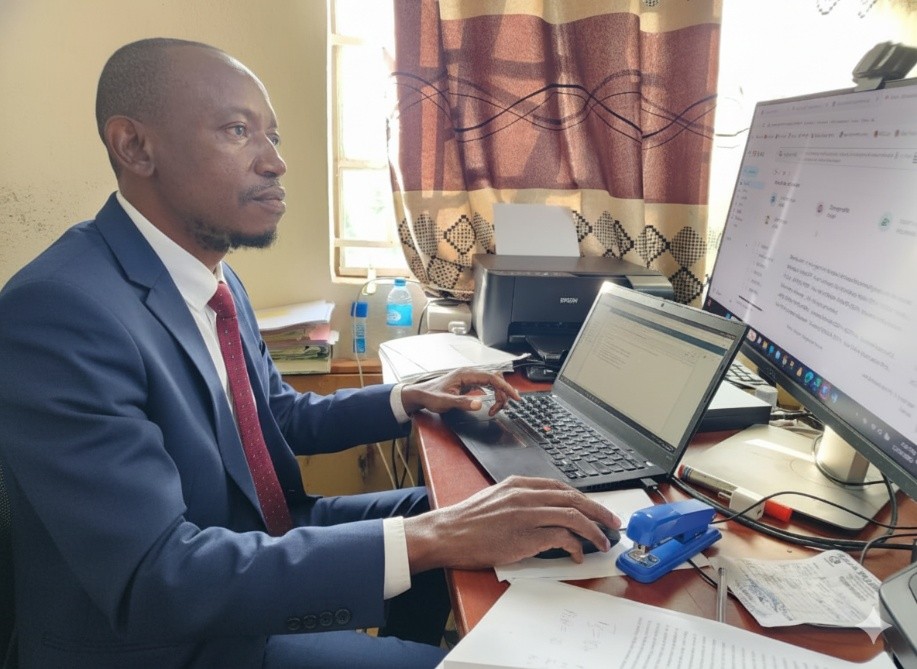
Foday Alhasan is a data manager at KGH-VHF who worked on both X100 and Enable. We caught up with him to learn how IAVI X100 has strengthened data management at KGH-VHF.
As a data manager, you’re responsible for ensuring the quality and completeness of study data. What is data management and why is it so important to successful vaccine development?
High-quality data ensures the accuracy, reliability, and integrity of the results of observational and experimental research, including vaccine trials, from evaluation of disease incidence and immune responses to monitoring safety. Poor-quality data can potentially invalidate trial results, compromising an entire study. Data management is key to this, ensuring all information collected from participants throughout screening, enrolment, follow-up, and endpoint assessment is captured and documented accurately in a standardized way and stored securely.
X100 is helping improve our understanding of Lassa fever, but how is it supporting the clinical development of a Lassa fever vaccine?
X100 is generating high-quality evidence on immunity, exposure history, and incidence of and risk factors for LASV infection. For example, by measuring anti-LASV antibodies at enrollment and follow-up in different regions of Sierra Leone, we’re providing critical data on disease transmission. All of this will help inform clinical trial design and protocol development, including the selection of clinical trial centers. X100 is also evaluating community interest in a Lassa fever vaccine and exploring indicators for vaccine hesitancy. This is providing valuable insights for future implementation strategies.
How was data management at KGH-VHF before X100?
I was fortunate to work on both X100 and Enable. Before these studies, most research at KGH-VHF used local, manual data entry. This caused significant delays as field teams first recorded information on paper before transferring it into electronic databases. Although the data team worked diligently, the limited automation and absence of real-time electronic tools made quality assurance and data cleaning more complex and time consuming, increasing the risk of errors. In this context, coordinating between field teams, clinical staff, and the data office could also be challenging.
How has X100 strengthened critical data management capacities to prepare KGH-VHF for future vaccine trials?
Through both studies, we’ve modernized the data management infrastructure at KGH-VHF to meet international research standards, strengthening institutional readiness for future trials. Both X100 and Enable used REDCap databases that were developed and implemented by Epicentre. Epicentre provided critical structure and oversight following database implementation, including standardized procedures and regular monitoring. Through this collaboration, we’ve improved essential data management practices; enhanced communication between the clinical, laboratory, and data teams; and learned how to work with an external, centralized data center. This ensures KGH-VHF is positioned to contribute to multi-center trials and conduct high-quality research to support the development of lifesaving interventions to benefit people in our region.
How have you been involved in X100?
As KGH-VHF’s data manager for X100, I led all data-related activities throughout enrollment and follow-up. This included training field staff on the REDCap data system, monitoring enrollment and follow-up dashboards, and ensuring daily oversight of progress and data completeness. I collaborated closely with Epicentre throughout to maintain high standards of data quality and provided regular updates to partners on enrollment and follow-up performance and data integrity.
How has working on X100 supported your own professional development?
This experience strengthened my competencies in clinical research data management, including of complex electronic datasets. I’ve also gained hands-on experience in training and supervising field and clinical staff on using electronic data systems to support timely, accurate reporting. Thanks to the collaboration with the teams at Tulane University, Epicentre, and IAVI, I also developed valuable communication and project management skills. This has all prepared me to contribute to future vaccine trials in accordance with global data standards.
With X100 wrapped up, what are your goals for the future?
I’m motivated by how data driven insights can strengthen public health decision making around outbreak response to improve healthcare delivery. I’m particularly interested in working with complex datasets, identifying trends, and supporting the data-driven development of lifesaving interventions, especially for diseases like Lassa fever that overwhelmingly affect vulnerable populations. I look forward to advancing my expertise in data science and public health informatics. My long-term goal is to support national and global health programs through high quality data systems.
****
About Foday Alhasan
Alhasan is a data manager at the Viral Hemorrhagic Fever Program at Kenema Government Hospital (KGH-VHF) in Sierra Leone. Foday oversees all data-related activities supporting clinical care and research to strengthen evidence-based decision-making and enhance research capacity. His work involves supervising data entry processes, supporting study teams, and ensuring high quality, reliable data for clinical and epidemiological research projects. Alhasan played a key role in managing data for IAVI X100 and is currently data manager for the Enable study. He received a BSc in Computer Science at Njala University and holds certifications in REDCap EDC system, GCP, and HSP. He also provides training to field staff on electronic data capture tools to improve data quality and workflow efficiency.