June 29, 2026
Optimizing antibodies for antimicrobial resistance
IAVI harnesses its prowess in antibody isolation, engineering, and optimization to expand its portfolio of vaccines and monoclonal antibodies against multiple bacterial pathogens.
It is hard to imagine that one of the world’s most urgent public health threats is often referred to as the silent pandemic. Yet antimicrobial resistance (AMR) is quietly raging across the globe. Today, AMR is directly responsible for killing 1.3 million people every year. But it is associated with a much higher death toll — 5 million deaths worldwide are attributed in some way to AMR, with the majority occurring in low- and middle-income countries.
Antimicrobial resistance arises when bacteria, fungi, or viruses evolve and develop resistance to the most commonly available treatments. For bacteria, this is often a result of an overuse or misuse of common antibiotics, both in human populations and in agricultural practices. As antimicrobial treatment proliferates, so has the threat of AMR. According to a study by the Global Research on Antimicrobial Resistance Project published in 2024, more than 39 million people could die from antibiotic-resistant infections over the next 25 years.
Improving care and access to existing antibiotics, as well as developing new small-molecule therapeutics, will help ensure this projection doesn’t become reality. But other strategies are also essential to address the threat AMR poses to global health, including developing new and improved vaccines and monoclonal antibodies (mAbs) for both treatment and prevention.
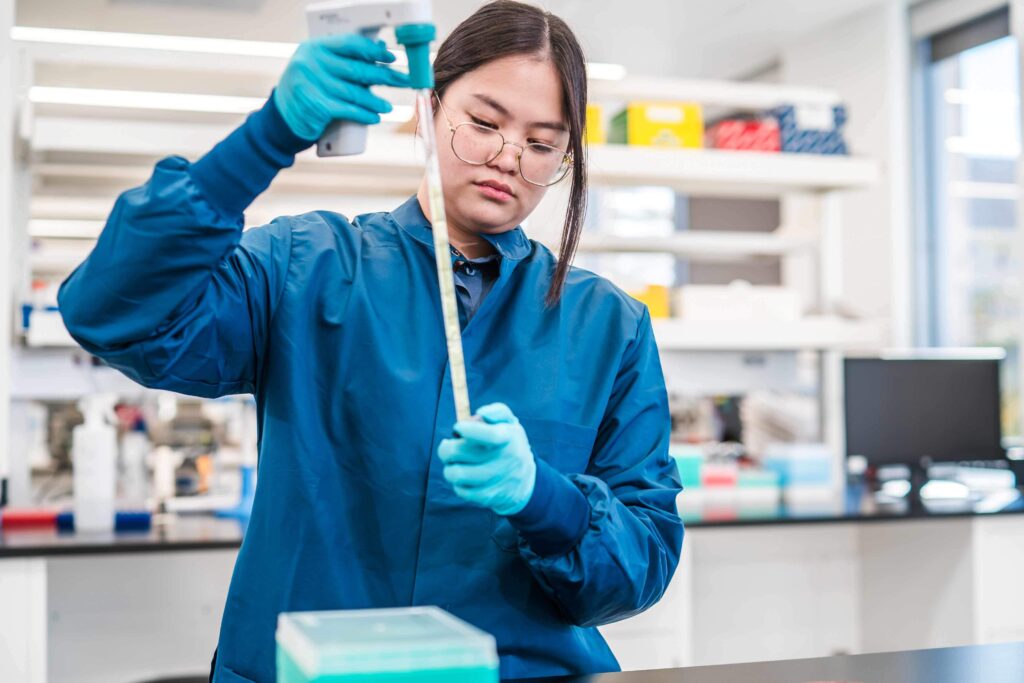
This is where IAVI’s prowess comes into play. “IAVI is leveraging its skills and expertise honed through its HIV vaccine and antibody programs to develop new preventives for antimicrobial-resistant bacterial pathogens,” says Jon Heinrichs, who leads IAVI’s discovery science efforts.
In 2019, IAVI’s Neutralizing Antibody Center (NAC) in La Jolla began a discovery program to identify and optimize human antibodies against Shigella bacteria, a leading cause of diarrheal disease in low- and middle-income countries that results in substantial morbidity among children, and as a result is one of the WHO’s priority AMR pathogens.
With funding from Wellcome, IAVI scientists at the NAC set out to understand what constitutes a broadly effective antibody response against Shigella. These antibodies could then be used as tools to reverse engineer improved vaccines or could be further enhanced and developed as preventive or therapeutic mAb options.
But just as with HIV, there are many challenges. Antibodies against most bacterial pathogens, including Shigella, target and bind to the polysaccharides — large carbohydrate molecules composed of smaller sugar molecules — that coat the bacterium’s surface. The structure of these polysaccharides is highly variable, even within a single bacterial species, necessitating the engineering of mAbs that are both more potent and active against a wider breadth of isolates, or even bacterial families.
The IAVI team screened human samples to identify antibody variants against Shigella flexneri (a specific species of Shigella bacteria) and then applied a creative strategy to screen and rapidly mature a selection of these antibodies through the accrual of specific mutations. Through this process, scientists identified one or two specific mutations that enhanced the mAb binding affinity to the Shigella flexneri polysaccharides. The mAb variants with improved affinity also had greater neutralization breadth, making them cross-reactive against an additional Shigella flexneri serotype, as well as even some other bacterial species.
This work was recently published in the Journal of Biological Chemistry, and lead author Nick Xerri, a research scientist at IAVI’s NAC, is hopeful that it will serve as an important first step in engineering antibodies against the polysaccharides of bacterial pathogens, thereby making mAbs a viable weapon against the growing threat of AMR.
“This proof of concept can now hopefully be applied to other antibodies that bind bacterial sugars to expand not only their potency, but also their breadth,” Xerri says. “Some of the cross-reactive antibodies that we have found also bind to other bacteria, and if we can start improving the potency and breadth to maybe even hit other bacteria that share common sugar epitopes, then you could potentially utilize that to have one antibody that targets multiple bacterial pathogens.”
Heinrichs refers to this as the holy grail approach. “You could either combine novel antigens for multiple bacteria and have a vaccine similar to the pneumococcal conjugate vaccine, or you could use these broadly protective antibodies that are effective against more than one pathogen on their own as a preventive or therapeutic. That would be a tremendous finding for the field,” he says.
In other work on Shigella, IAVI scientists analyzed the immune responses induced by Shigella infection in both non-human primates (NHPs) and humans. The work in NHPs was the result of a partnership with researchers at the Wisconsin National Primate Research Center following a years-long Shigella outbreak caused by two lineages of Shigella flexneri similar to those that infect and sicken humans. The human immune analysis stemmed from a controlled human challenge study of Shigella infection in seven volunteers, conducted in partnership with Johns Hopkins University.
The combined analysis of more than 160 NHP and human antibodies from these two sources indicates that where the antibodies bind is an important issue. Antibodies targeting antigens on the polysaccharide were highly cross-reactive against different Shigella serotypes, whereas other antibodies directed toward the bacterial surface could either enhance or prevent disease depending on the specific target epitope. This suggests that understanding antibody/antigen interactions will be critical in both optimizing vaccine antigens and developing mAbs for the treatment and prevention of Shigella.
By building out research and funding partnerships, IAVI aims to develop a portfolio of vaccine and mAb candidates to help curtail the pandemic of antimicrobial resistance.