October 14, 2026
Advancing preparedness for future epidemics
New Sudan virus vaccine results published in The Lancet Microbe.
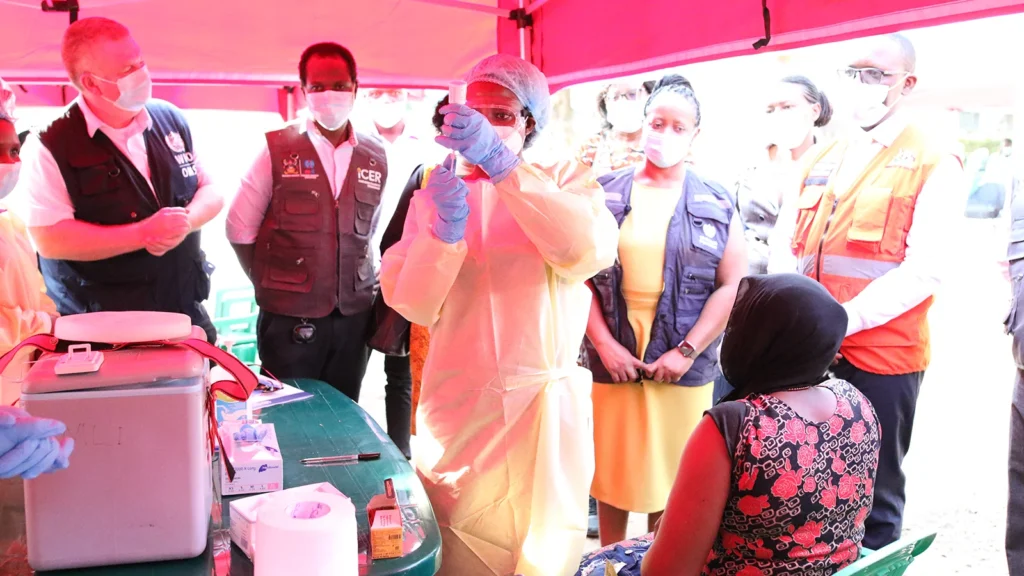
IAVI is pleased to announce the publication of results from IAVI C108, a first-in-human Phase 1 clinical trial (NCT05724472) of the rVSV-vectored Sudan virus vaccine rVSVΔG-SEBOV-GP* in The Lancet Microbe. Sudan virus (SUDV) is an orthoebolavirus responsible for deadly and increasingly frequent outbreaks in African countries.
In this single-blind, placebo-controlled, dose-escalation trial conducted at two sites in the U.S., 36 adults in good general health received a single intramuscular dose of rVSVΔG-SEBOV-GP at different doses, or placebo. Analysis of safety and immunogenicity data showed that rVSVΔG-SEBOV-GP was well tolerated and immunogenic at all the three doses studied.
There are no approved vaccines to prevent Sudan virus disease, so these results are an important addition to the field. They provided key evidence supporting the use of rVSVΔG-SEBOV-GP during the 2025 Sudan virus disease outbreak in Uganda through the Tokemeza SVD trial. While IAVI C108 evaluated rVSVΔG-SEBOV-GP, a candidate vaccine originally produced by Merck/MSD, IAVI is now advancing rVSV∆G-SUDV-GP, which is genetically identical but manufactured using an updated process designed to support future clinical development and potential deployment. Currently, IAVI’s product rVSV∆G-SUDV-GP is being evaluated in a Phase 1 clinical trial in the U.S. (NCT07565090).
The crisis of the current Bundibugyo virus (BDBV) epidemic in the Democratic Republic of the Congo is a prime example of the importance of outbreak preparedness. Though this orthoebolavirus was identified in 2007, no vaccine candidates were ready to deploy, even in field trials, when the epidemic emerged. Four months later, Phase 1 trials have begun for two investigational BDBV vaccines, but in the meantime, over 9,000 people have become ill and about half have died.
At IAVI we remain committed to advancing vaccines for epidemic-prone diseases and we are currently leveraging the rVSV platform (used in MSD’s approved and WHO-prequalified vaccine for the prevention of Zaire ebolavirus) for other vaccine candidates under development, including for Bundibugyo, Marburg, Crimean Congo hemorrhagic fever, and Lassa viruses.
This project has been supported in whole or in part with federal funds from the U.S. Department of Health and Human Services; Administration for Strategic Preparedness and Response; Biomedical Advanced Research and Development Authority (BARDA), under contract number 75A50121C00077.
IAVI extends thanks to all the colleagues, collaborators, and volunteers who made this work possible. Partners include MSD, which donated the candidate vaccine; Imperial College London for clinical immunology; and the clinical sites for trial conduct.
Laufer DS, Marini A, Philiponis V, Fast PE, Zaric M, Sigei F, Bromell RV, Fernandez N, Hayes PJ, Yun H, Varma R. Safety and immunogenicity of a recombinant vesicular stomatitis virus-based Sudan virus vaccine in adults in the USA: a single-blind, first-in-human, dose-escalation phase 1 clinical trial. The Lancet Microbe. 2026 Sep 23.
*In 2022 MSD, known as Merck in the United States and Canada, produced and donated to IAVI vials of rVSV∆G-SEBOV-GP candidate vaccine from existing investigational drug substance to supplement IAVI’s ongoing Sudan virus vaccine development program. IAVI now acts as developer and regulatory sponsor and is responsible for all aspects of future development of rVSV∆G-SEBOV-GP.