July 6, 2026
Vaccination induces HIV bnAbs in primates, bolstering germline-targeting strategy
New study published in Nature shows for the first time elicitation of broadly neutralizing antibodies to HIV in a stringent animal model.
One of the biggest challenges in HIV vaccine research has been the virus’s extraordinary diversity. While broadly neutralizing antibodies (bnAbs) capable of blocking many HIV strains do arise naturally in some people, finding a way to elicit them through vaccination has remained elusive.
A new study published in Nature by researchers at Scripps Research; IAVI’s Neutralizing Antibody Center (NAC); La Jolla Institute for Immunology; Fred Hutch; Emory National Primate Research Center and Emory Vaccine Center; The Ragon Institute of Mass General, MIT, and Harvard; MIT; Howard Hughes Medical Institute; and University of California, San Diego offers a compelling proof of concept that this goal may be achievable. A carefully designed germline-targeting vaccine regimen successfully induced bnAb-class responses in nonhuman primates (NHPs), demonstrating for the first time that this approach can generate mature, HIV-neutralizing antibodies in a stringent animal model.
Lead author Jon Steichen will be presenting this work at the upcoming AIDS 2026 conference in Rio de Janeiro on July 26, in a talk entitled “V3 Glycan bnAb response: NHP proof of principle data,” part of the preconference workshop Advancing HIV prevention science and access – Session 3: Basic science shaping the future of HIV prevention: Innovations in HIV vaccine development.
HIV germline targeting is a vaccine strategy that aims to guide the immune system to generate antibodies with sufficient breadth and potency considered necessary to prevent HIV acquisition. It begins with vaccination to activate rare precursor B cells with specific genetic features shared by known bnAbs targeting HIV, then uses a series of engineered booster immunogens to shepherd those cells through the process of affinity maturation until they acquire the breadth and potency needed to neutralize diverse HIV strains.
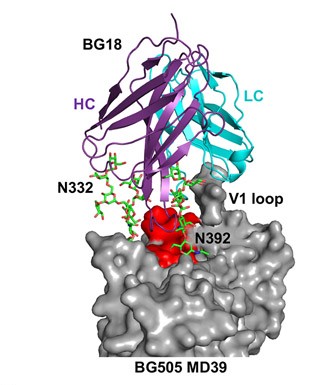
In this study, the team designed a sequential immunization regimen aiming to elicit potent bnAbs like BG18, which target the V3-glycan epitope on the HIV envelope — one site of vulnerability to such bnAbs. The regimen combined a protein-based germline-targeting priming immunogen with an adjuvant, followed by a series of boosters that reintroduced features of the native virus, exposing the immune system to increasing antigenic complexity. The final step was introducing polishing immunogens to see if they could culminate in induction of broad and potent responses to bind and neutralize multiple strains of native HIV.
The results were striking: bnAb B cell lineages were generated in more than half of the animals, and vaccine-elicited antibodies neutralized a diverse panel of HIV isolates. Some antibodies achieved neutralization breadth approaching that of naturally occurring bnAbs, and serum from the best-performing vaccinated NHP showed activity consistent with levels expected to confer protection in preclinical models.
Equally important, structural analyses confirmed that the antibodies elicited by vaccination closely mimicked the binding mode of the target bnAb class, validating the precision design of the immunogens. The study also demonstrated that extremely rare precursor B cells characteristic of mature BG18 bnAbs can be expanded and matured through multiple rounds of vaccination.
The implications extend beyond HIV. By showing that vaccine design can reliably steer antibody evolution toward predefined targets, this strategy could inform efforts against other highly variable pathogens.
The priming immunogen used in this study was evaluated in humans in the HVTN 144 trial and is currently being tested in the Phase 1 trial IAVI G004.
Though the findings described in this publication involve NHPs, the study represents a major step forward by demonstrating that the long-envisioned goal of eliciting bnAbs through vaccination is not only theoretically sound, but experimentally achievable. Further work will focus on simplifying that vaccination regimen and improving its efficiency.
Funding for this study was generously provided by the National Institute of Allergy and Infectious Diseases (NIAID), the Gates Foundation under the Collaboration for AIDS Vaccine Discovery, and IAVI.
Authors: Jon M. Steichen, Patrick J. Madden, Claudia T. Flynn, Swastik Phulera, Monolina Shil, Oleksandr Kalyuzhniy, Alessia Liguori, Carolyne Kifude, Leigh M. Sewall, Christopher A. Cottrell, Krystal M. Ma, Sabyasachi Baboo, Jolene K. Diedrich, Katherine McKenney, Allan C. deCamp, Diane G. Carnathan, Ivy Phung, Parham Ramezani-Rad, Ester Marina-Zárate, Brian Freeman, Zhenfei Xie, Jeong Hyun Lee, Troy Sincomb, Nicole Phelps, Danny Lu, Diana Goodwin, Ryan Tingle, Yumiko Adachi, Nushin Alavi, Jenny Tran, Andy S. Tran, Alyne Nascimento, Catherine Sovie, Daniel L. V. Bader, Hannah Voic, Xiaoya Zhou, Grace Pixton, Agnes Walsh, Mariane B. Melo, Torben Schiffner, Facundo D. Batista, Dennis R. Burton, Darrell J. Irvine, James C. Paulson, John R. Yates III, Gabriel Ozorowski, Andrew B. Ward, Guido Silvestri, Shane Crotty, William R. Schief
Reference
Steichen JM, Madden PJ, Flynn CT, et al. Vaccination elicits HIV broadly neutralizing antibodies in primates. Nature. Published online June 30, 2026. doi.org/10.1038/s41586-026-10837-5.